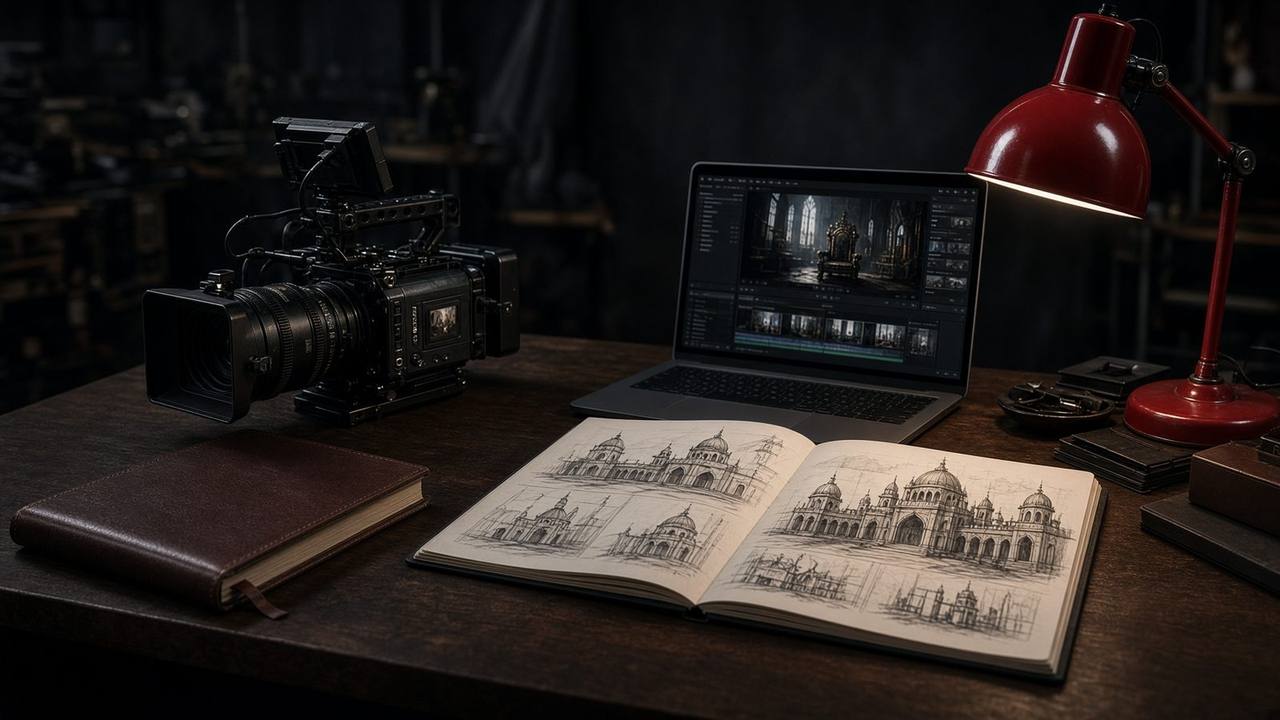
DaKreator38 AI Filmmaking Masterclass
Don't just use AI. Learn to direct with it.
A live cohort built on the Volume 1 draft: story, character, world, camera, prompting as direction, performance, preproduction, motion, edit, sound, and the studio system. Not a prompting class. Not a tool tutorial.
Source
DaKreator38 AI Filmmaking Bible · Volume 1
From Imagination to Cinema · Volume 1
The class is drawn from Julius Nzang’s Volume 1: From Imagination to Cinema. Classroom stills are DaKreator38 production frames. This is not a book for sale on this site.
How the room works
- 01Opening principle from the draft
- 02Lecture and discussion
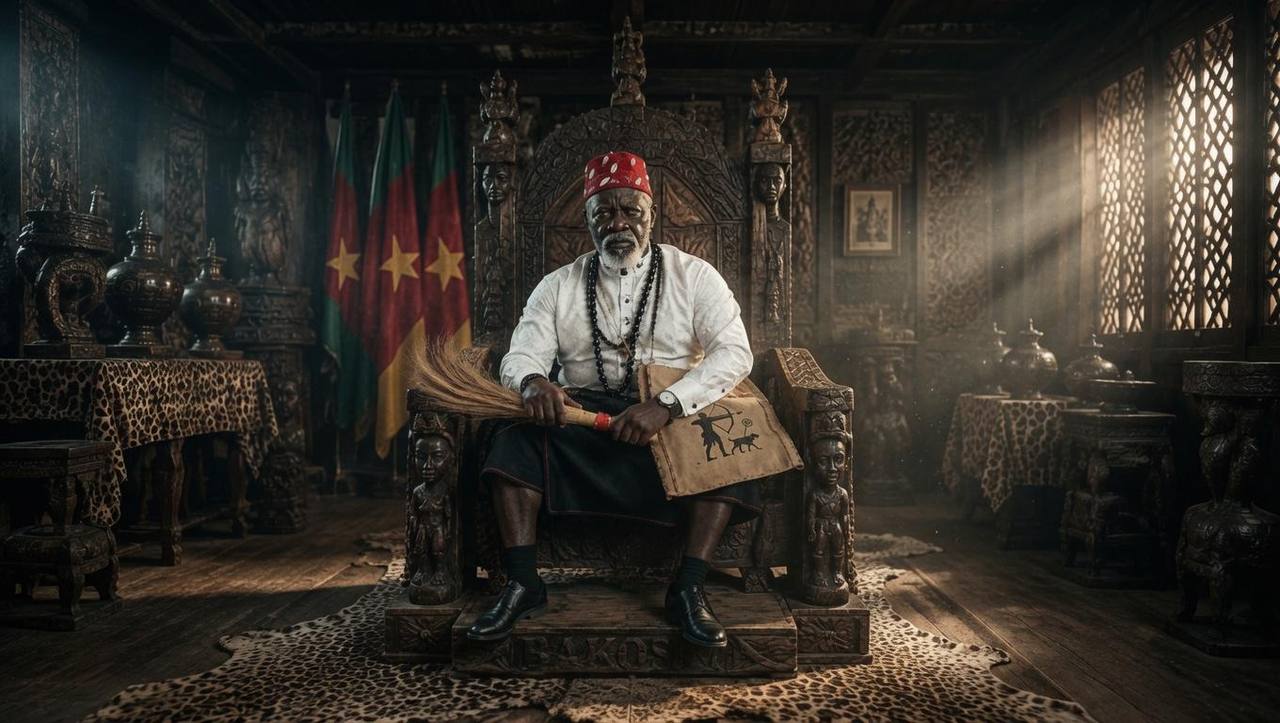
- 03Traitor King / DaKreator38 case stills
- 04Live classroom lab
- 05Take-home before the next session
Curriculum
14 sessions. One system.
Live cohort. Each session follows Volume 1 in order — lecture, Traitor King case stills, classroom lab, take-home. Open a session for outcomes, excerpts, labs, and plates.
01
OpenThe AI Filmmaker Mindset
From user to director
Generation produces possibilities. Direction gives those possibilities purpose. Session one installs the mental shift the rest of the cohort depends on.
Chapter 01 · Chapter 02
Leaves with · One decorative prompt rewritten as four director questions. No generator opened.
02
OpenStorytelling for AI Cinema
The story determines why the world matters
When creation becomes easier, the need for meaningful storytelling becomes greater. An idea is a possibility. A story is a journey.
Chapter 03
Leaves with · A one-page treatment that can survive a tool change: want, obstacle, choice, consequence.
03
OpenCharacter Creation
A face is not a character
AI can generate faces. Filmmakers create characters. The difference is identity — history, desire, fear, belief, contradiction, and choice.
Chapter 04
Leaves with · Six-part Character Bible skeleton for one lead. Identity and psychology filled in the room.
04
OpenThe Digital Actor System
Identity that survives the next shot
A digital actor has to be built, then preserved: appearance, psychology, voice, movement, performance. The image introduces the character. The identity sustains them.
Chapter 05 · Appendix B
Leaves with · Five-layer actor lock and one approved master portrait. Do not redesign the face before Session 09.
05
OpenWorld Building for AI Cinema
A location is not a world
A location answers where the scene happens. A world answers why this place matters — geography, history, culture, conflict, and what the landscape remembers.
Chapter 06 · Appendix C
Leaves with · A World Bible page for one location that cannot be swapped for a generic alternative.
06
OpenThe Language of Cinema
The camera teaches the audience how to feel
Shot size, angle, movement, light, and what you refuse to show. A prompt should begin in the head as a shot — not in the generator.
Chapter 07 · Appendix D
Leaves with · One dramatic moment designed three ways. Shot Design Template filled. No prompt yet.
07
OpenPrompting as Direction
Do not prompt for pictures
A prompt is translation, not origin. The Eight-Layer Prompt Architecture turns a decided shot into instructions a system can interpret.
Chapter 08 · Appendix A
Leaves with · One shot built through all eight layers, plus a tool-first version you refuse.
08
OpenDirecting AI Actors
Intention, not motion
A moving character is not necessarily an acting character. Performance begins when the audience senses a mind behind the movement.
Chapter 09
Leaves with · One line directed three ways, plus scene objective versus story objective.
09
OpenPreproduction for AI Cinema
Build before generating
The danger in AI production is not always scarcity. It is uncontrolled abundance. Five locks turn possibility into a plan.
Chapter 10 · Appendix E
Leaves with · Five locks set for your project, plus one scene broken down before any generation.
10
OpenFrom Still Image to Moving Shot
Meaningful change, not animation
A still captures a moment. A shot contains time. Direct the event: beginning state, change, ending state. Do not animate the image.
Chapter 11
Leaves with · One moving shot specified with a motion hierarchy: primary, secondary, environment, performance, camera.
11
OpenEditing the AI Film
Selection creates the film
Generation creates possibilities. Editing creates meaning. A shot should survive because it serves the film, not because it was difficult to generate.
Chapter 12
Leaves with · A six-shot sequence run through the Four-Pass Edit. One beautiful shot cut.
12
OpenSound Design and the Invisible World
Belief lives off-screen
The audience sees the world through the image, but they believe the world through sound. Do not add score to a broken scene. Build the world we cannot see.
Chapter 13
Leaves with · A Sound Bible for one location, designed with the music stripped out.
13
OpenProduction Management
Systems that protect the vision
A creator finishes a project. A studio builds the capability to finish again. Five pillars: organization, documentation, version control, approval, creative memory.
Chapter 14
Leaves with · Seven production folders and a filename that does not say final_USETHIS.
14
OpenThe Future AI Filmmaker
The question the book leaves
The question will no longer be: Can this be made? It will become: Is this worth making? The last session is authorship, the manifesto, and the Final Word.
Chapter 15 · Final Word · Appendix F
Leaves with · The Future Filmmaker Audit, written in your own hand, and one answer: What story are you responsible for telling?
Practical Toolkit
Appendices A–F
Volume 1 turns the method into working documents. Each template is taught in the session that uses it — not sold separately, not promised as a download on this site.
Appendix A
Master Prompt Template
Turns a decided shot into eight-layer direction. Session 07.
Appendix B
Character Bible Template
Locks identity so the face is not redesigned every shot. Session 04.
Appendix C
World Bible Template
Protects geography, history, culture, rules, and sound. Session 05.
Appendix D
Shot Design Template
Designs the shot before any prompt is written. Session 06.
Appendix E
AI Film Production Checklist
Ten phases from concept through delivery. Session 09.
Appendix F
DaKreator38 AI Filmmaking Workflow
Imagine. Direct. Produce. Edit. Release. Session 14.
What you leave with
A method. Not a promised picture.
The cohort does not sell a finished short or a seat count. You leave with directed work, bibles you can hold, and a production system you can run again — the same discipline used on Kings and Queens Vol. 1: The Traitor King.
- A directed scene pack: shot design, eight-layer direction, and performance notes — not a guaranteed finished short
- A Character Bible for one digital actor you can hold across shots
- A World Bible for one location that participates in the story
- A five-lock preproduction pack, a Sound Bible, and a seven-folder system you can run again
Instructor
Julius Nzang
Founder · Director · Story Architect · Educator
Julius Nzang founded DaKreator38 Studios to train filmmakers who can hold a story in one hand and a new camera in the other. Volume 1 is the method he uses on the slate: bible first, coverage second, taste always. The draft is the source text. The class is live.
The door
Start date to be announced
Interested? Write the studio. No payment is taken on this site.
studio@dakreator38.com